December 25, 2018
How Commodities Turn Monopolies? A Controversial View
For over 300 years, great minds reasoned that corporations only goal is maximizing shareholders value. Meeting that objective occurs as we generate sustainable economic profit- the holy grail. Since the inception of the modern corporate world, a crusade swept to find that holy grail, splatting blood, with measures like sales, gross profits, and EBITDA, to CROI, EVA and ROIC.
Economic Profit — the Holy Grail
It is intuitive.
Economic profit is the difference between the revenue received from the output and the opportunity cost of the inputs.
To generate revenues from the sale of outputs, customers must buy. They only do so for outputs that have the value that enhances their well-being. Nothing else matters if customers don’t buy, really.
That is intuitive; yet, measuring output value created has been less so.
Example from the constructions industry
LimestoneCo mines, extracts, and sells limestone. CementCo buys and turns it into cement for building companies like BuildingCo.
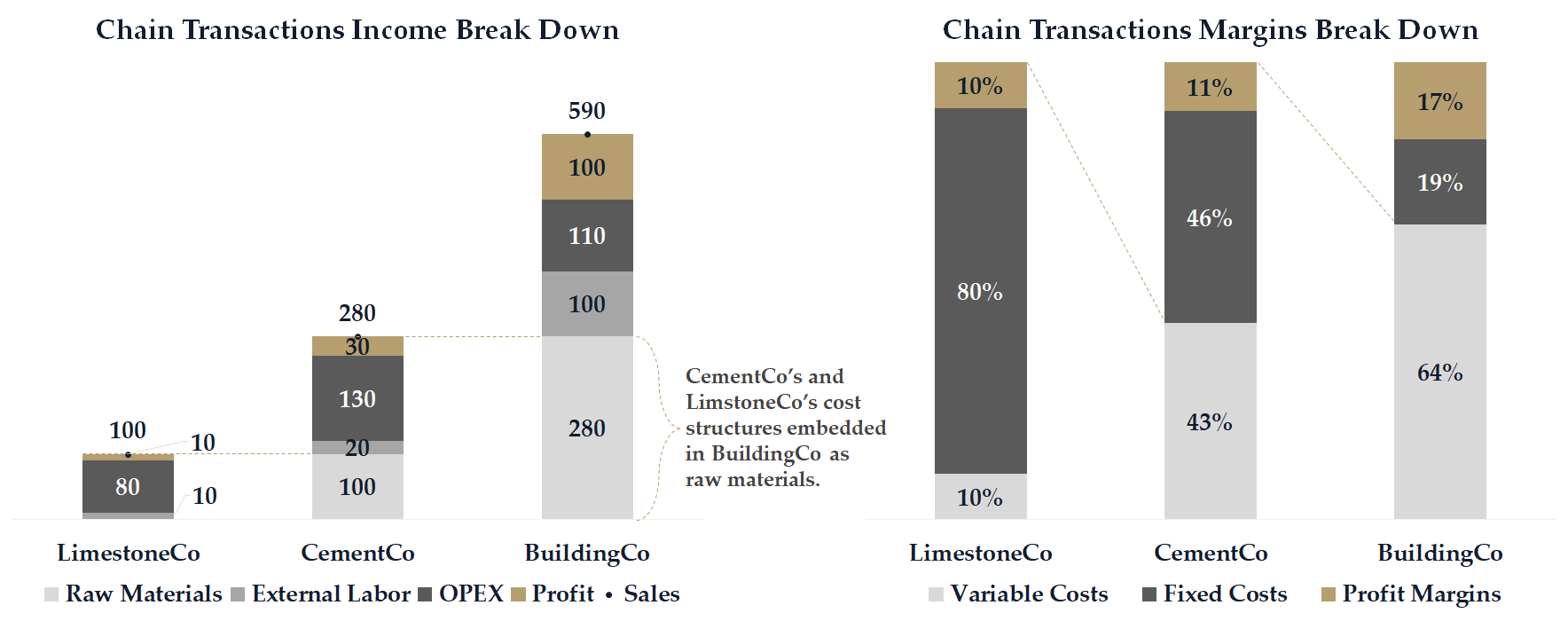
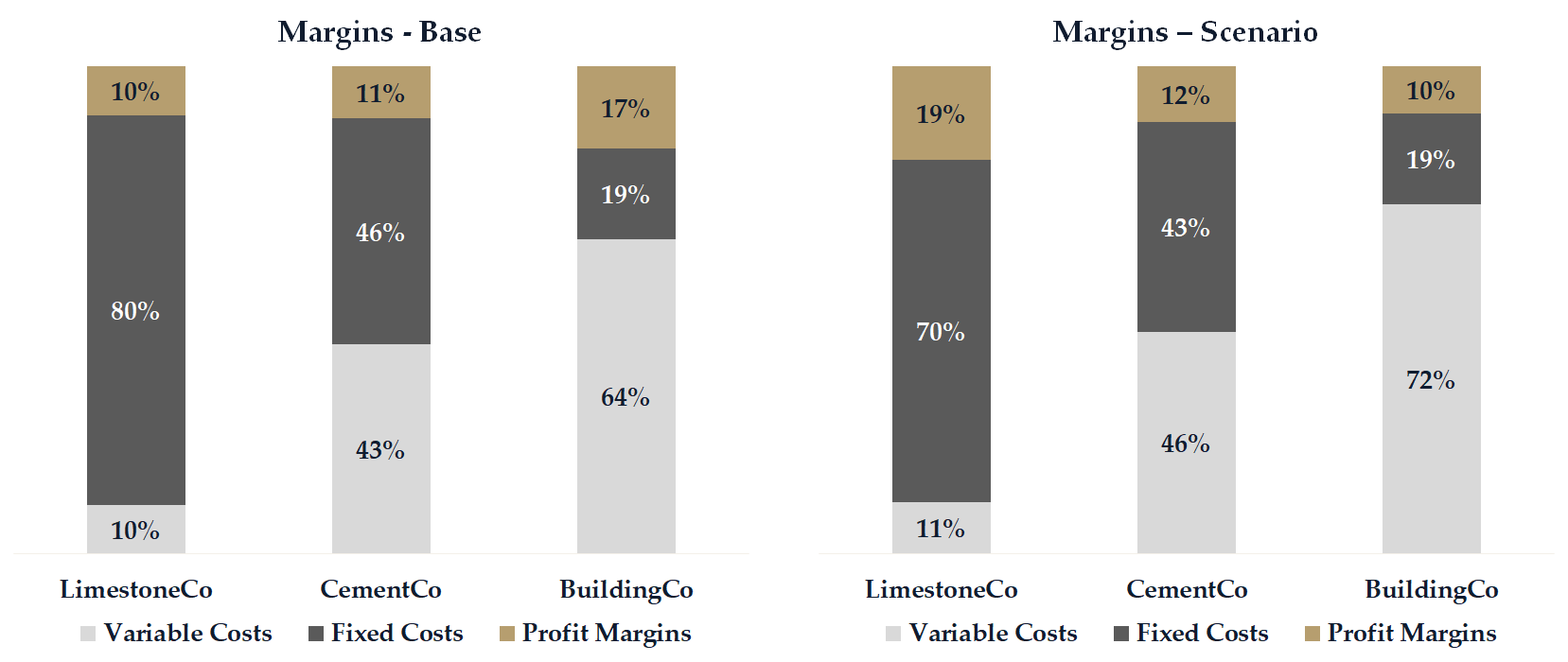
On the left, are incomes of the three companies transacting. On the other side, their margins.
Observations:
-
BuildingCo is asset-light (64% variable cost). LimestoneCo is asset-heavy (80% fixed costs)
-
LimestoneCo produces a commodity product, BuildingCo builds home, and CementCo is in between.
-
BuildingCo indicates a low contribution margin, while significantly high for LimestoneCo heavy assets.
-
BuildingCo margins are almost double LimestoneCo’s.
-
CementCo and LimestoneCo cost structures are embedded in BuildingCo’s.
So on and forth. Usually, more observations come through as we delve into the financial statements, build top-down and/or bottom-up models, to value the business.
That valuation process starts with sales, costs, and margins, to end with valuation.
Measuring value creation at the top Line
Sales are the chief driver of economic profits. And since the concept of sales is inseparable from customer value creation, we will measure that from the get-go.
As said, customers only pay for things that have value, so we may assert that all sales resemble value created.
For BuildingCo to generate $590 sales, a customer(s) must have attributed that amount as the worth of its value. We value homes, that’s why we’re willing to pay to build them.
But did BuildingCo create all that $590 of value? To find out, we graphed the embedded value created. Like the embedded cost structure done above.
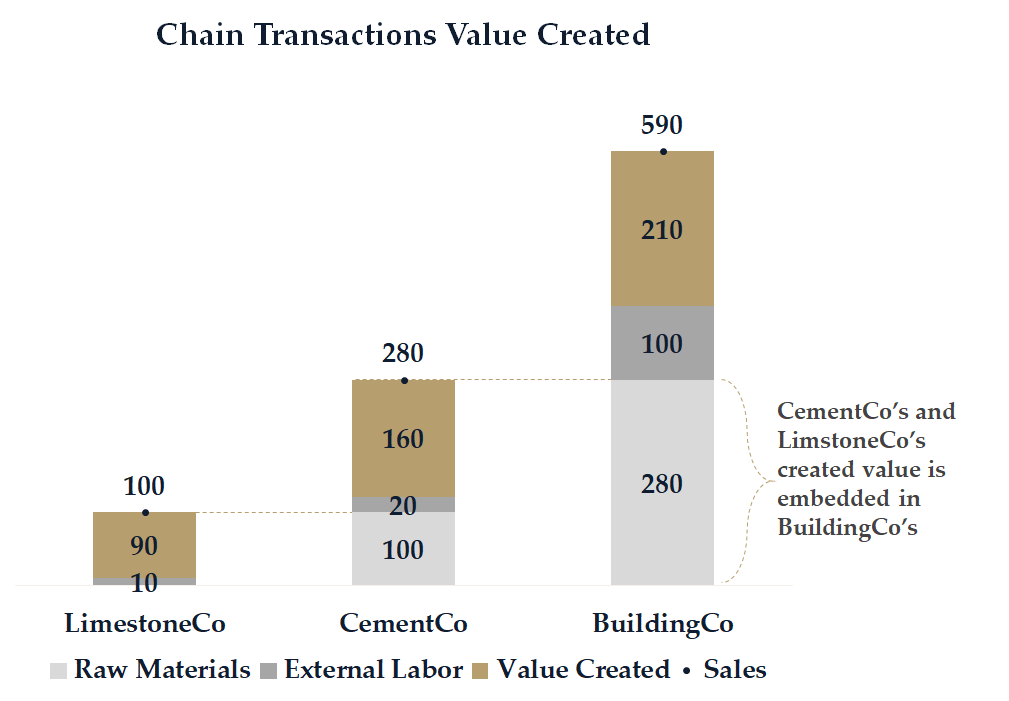
That means BuildingCo only created $210. The rest of the value created was external. Synonymous to assembly, BuildingCo assembled a few things and produced something that is worth more than the parts. Is it that simple? Yes, that’s how restaurants work, and pretty much everything else. That’s economics.
Economic growth occurs when we take resources and rearrange them in ways that are more valuable. As economist Paul Romer likened growth to the kitchen:
To create valuable final products, we mix
inexpensive ingredients together according to
a recipe…. Human history teaches us,
however, that economic growth springs from
better recipes, not just from more cooking.
To seek better recipes, we discern recipes from the mere ingredients. In BuildingCo’s case, the ingredients, that create value, are external and thus must be paid for. E.g raw materials, and sub-contractors. And BuildCo’s recipe (value created) is the difference between the total value (sales) and the externally created value by others.
It is intuitive.
Sustainable value creation is (the only) a competitive edge
And competitive edge is power.
Companies that create and sustain the most value posses a competitive edge. Their cost structures are important, only as underlying factors, though. They help explain how value creation is made and sustained. Analysts relying on cost structures, and other indicators, as standalone, may miss measuring what really matters.
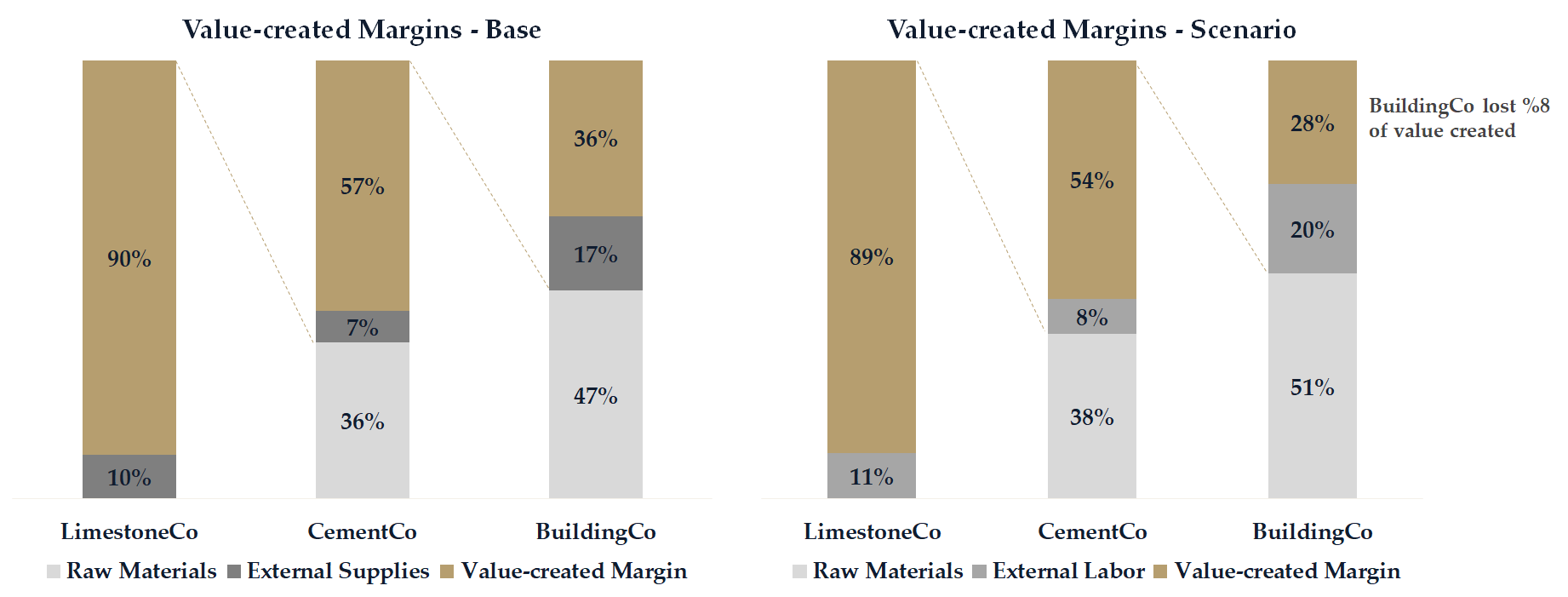
Instead, we calculate value created, then divide by sales to express value-created margins.
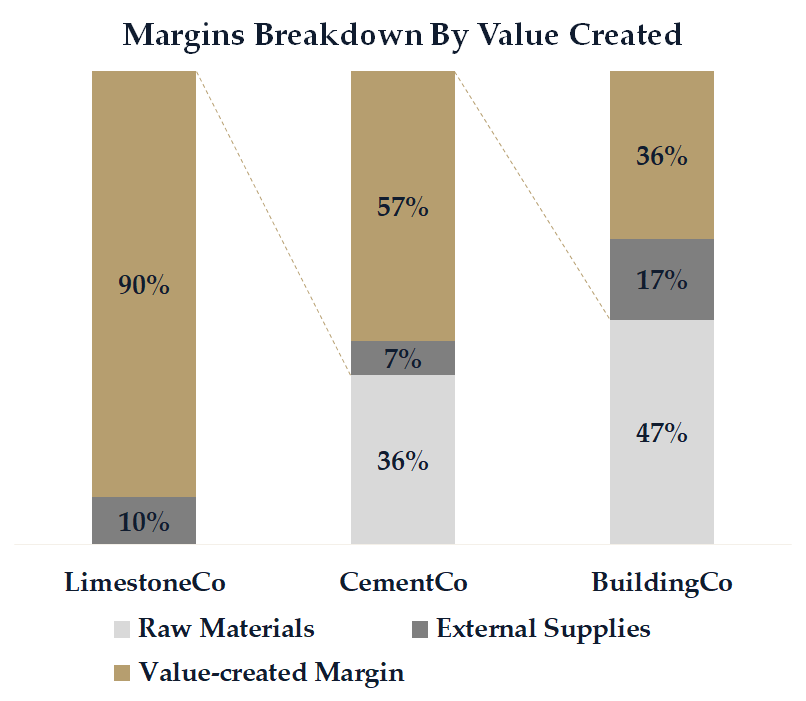
LimestoneCo value-created margin is 90%. From the total value of $100 created to CementCo, 90% of it belongs internally. Only 10% of LimestoneCo’s product value belongs to the actual rock!
And %36 of CementCo’s total value is attributed to LimestoneCo. Isn’t that a stand of power?
Sustainable value creation discerns a commodity as a monopoly
Imagine this — external supplies cost %20 more because of inflation and LimestoneCo decides doubling margins reasonable. The next happens –
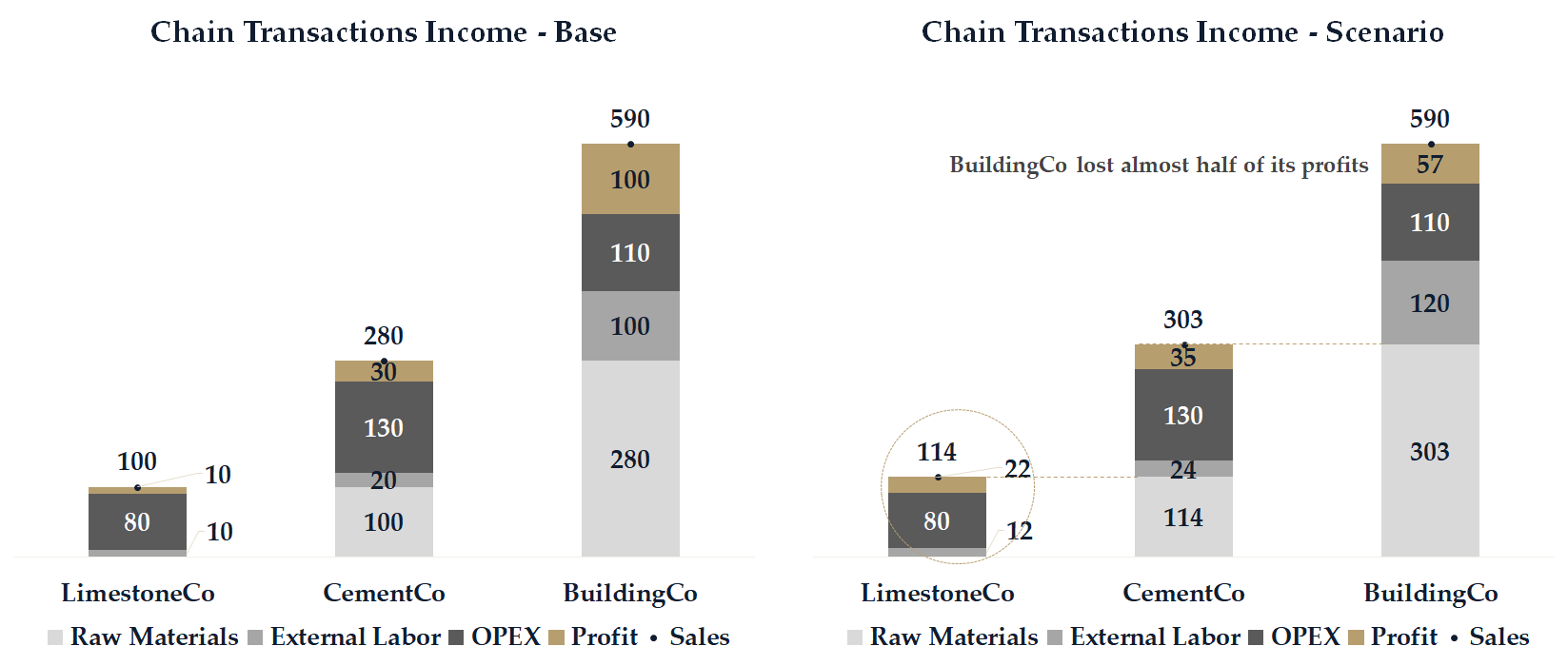
The “commodity” business ate almost half of BuildingCo’s profits. LimestoneCo did so not because of its optimal cost structure, operating strategy, or financial stability. It was able to do so because %64 of BuildingCo’s value created was external.
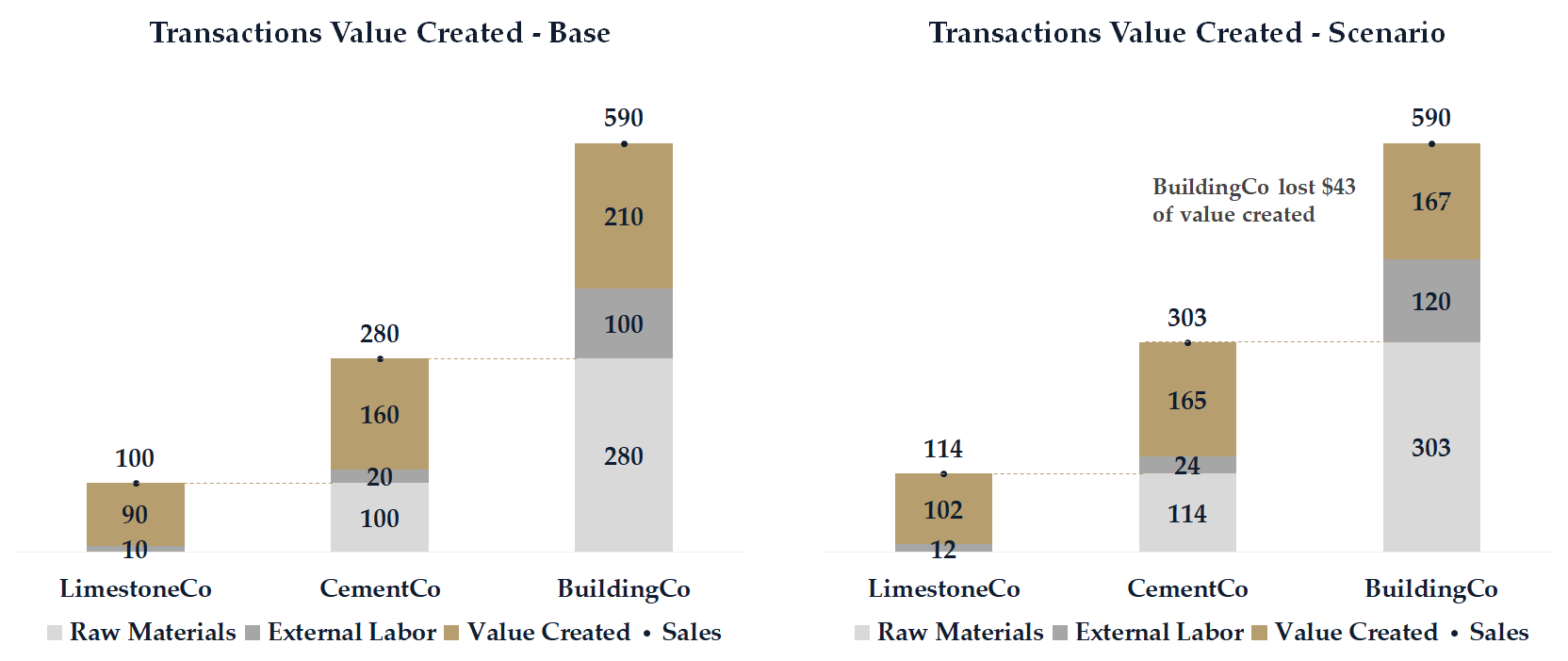
The heavy-asset commodity business, LimestoneCo, doubled its margins, in a whimper. CementCo maintained its margins by passing them down to BuildingCo.
Recall the $210 value BuildingCo created? it lost around a quarter of it, by just a mere cost increase, not by losing any market share.
The mind never thinks without a picture — conclusion
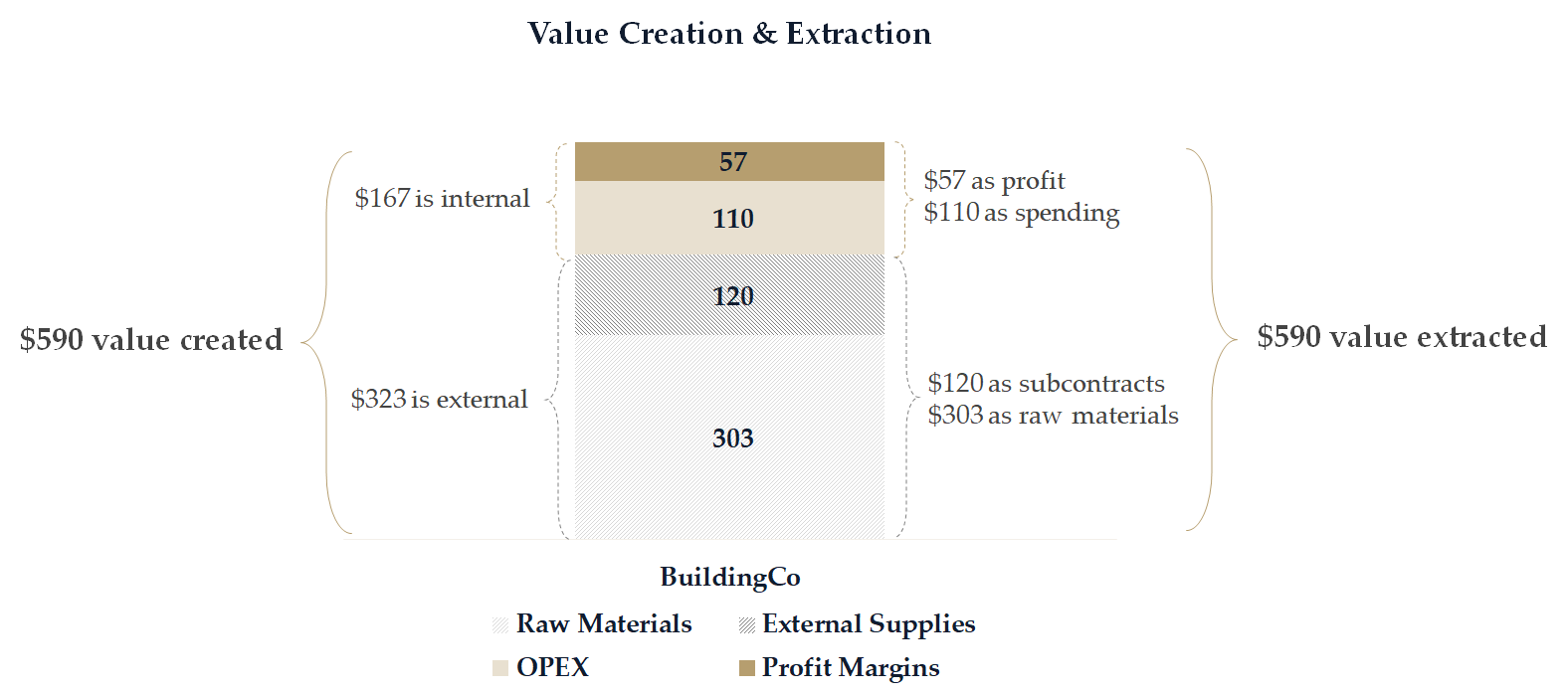
Could BuildingCo sustain its value created? That is the competitive edge question. The value creation and extraction cycle question. The “how companies sustain creating and extracting value” question.
-Abdulaziz Alnuaimi
It’s not profit, cash flows, or EBITDA of; it is the wealth of nations. I left the alternatives space to only seek that prosperity truism. Picture — an invite-only corporate intelligence firm principled on value investing, to preserve and grow the wealth of nations.